
The Loneliness of Starting Over
We love to celebrate new beginnings. We talk about the excitement, the possibilities, and the glamour of transformation. We admire the mountaintop—the achievement, the breakthrough, the dream realized.
But before you reach the mountaintop, you have to cross the valley.
The valley can be dark. It can be isolating. It can be frightening. But it can also be a place of discovery. The valley is where we learn. The mountaintop is where we appreciate the view and enjoy the rewards of our hard work. Most of life, however, is spent somewhere in between.
Starting over can be incredibly lonely.
I’ve been a loner for most of my life, long before I met my husband and long before I got married. Being a loner wasn’t about having difficulty making friends. It was about being willing to continue alone when necessary.
And there’s a difference.
Being alone doesn’t automatically mean being lonely. In my case, I was usually too busy pursuing goals to spend much time dwelling on loneliness. Of course, loneliness still crept in from time to time—we’re human. But when you’re focused on building something, there’s often little room to sit with those feelings for very long.
One lesson I’m still learning is that reaching your goal can bring its own kind of loneliness.
Sometimes the people you expected to celebrate your success aren’t the ones applauding when you arrive.
When I moved to France, one of the greatest gifts was entering a built-in community through the university system. Whether it’s a community college or a university, you’re surrounded by people with a shared purpose.
As a study abroad student, I benefited tremendously from that environment.
I participated in a work-study program that eventually led to part-time employment after graduation. The woman I worked for helped me find housing and later attended my wedding. She was also a fellow expat.
Another expat from New York City became one of my closest friends and confidantes. Through her, I met others who expanded my world even further. One of my university advisors introduced me to local expat organizations and eventually sang at our wedding.
Those relationships became part of the foundation of my new life.
Being a loner meant that starting over never scared me. I’ve always approached life with the understanding that if something needs to get done, I may have to do most of the work myself. I’ve certainly received help along the way, but I’ve learned not to depend on help arriving exactly when I need it.
I’ve always been willing to roll up my sleeves and figure things out.
That’s why moving abroad didn’t frighten me.
What frightened me was the thought of reaching middle age without ever attempting the things on my bucket list.
I didn’t want to spend the rest of my life wondering what might have happened if I’d taken the leap.
After arriving in France, I built a new community. Then I got married.
When planning our wedding, I completely understood that many people would be unable to attend. International travel requires time, money, and logistical planning. My husband and I even planned our celebration a full year in advance to give people plenty of notice.
What surprised me wasn’t who couldn’t come.
It was discovering who didn’t want to.
At first, I assumed practical limitations were the reason. Eventually, I realized that for some people, the issue wasn’t resources at all. It was a lack of interest. There was little enthusiasm for celebrating this new chapter of my life.
That realization was difficult.
Then, after I launched my YouTube channel and began sharing my story, I received an overwhelming amount of encouragement and support.
Until one comment.
One comment stood out because it wasn’t criticism of the content. It was deeply personal and filled with hostility. Reading it, I realized immediately that it wasn’t really about the video.
It was about me.
And suddenly, other pieces began to fall into place.
I started looking back and recognizing patterns I had overlooked for years. Moments that once seemed isolated now felt connected. Resentment I thought had been resolved had never truly disappeared.
Instead of feeling hurt, I felt liberated.
I finally understood.
Moving to France hadn’t simply expanded my geography—it expanded my world.
The texture of my life changed. My daily relationships changed. My sense of possibility changed.
None of that would have happened without a willingness to venture out alone.
Ironically, marriage has caused me to reevaluate my independence even more.
To be a good partner, I have to maintain a strong sense of self. Not only for myself, but for my husband as well. Our relationship benefits when both of us continue growing as individuals.
I am inspired by my husband, our friendship, and the life we’ve built together. I want to continue evolving, learning, and becoming a better version of myself.
But I also recognize that none of this would have happened if I hadn’t first been willing to walk alone.
I never would have moved to France.
I never would have taken opportunities in unfamiliar places.
I never would have rebuilt my community—not once, but multiple times.
Since arriving in France, I’ve essentially started over twice. Each time required me to step into uncertainty, navigate the valley, and build something new.
One piece of advice someone shared with me has stayed with me:
Even in marriage, you have to be willing to do things by yourself.
As I build my brand and pursue entrepreneurship, much of the work happens in solitude. The vision is shared with my husband because it contributes to our future together, but the daily work often happens alone.
And surprisingly, I value that.
I spend a great deal of time in solitude, even as a married woman. That quiet time allows me to listen to myself, reflect, create, and stay connected to who I am. It helps me show up more fully in my marriage when my husband comes home at the end of the day.
Likewise, my husband has his own passions, including coaching soccer. Our separate interests don’t divide us—they enrich our relationship. They give us new experiences to bring back to one another.
I’ve learned that partnership isn’t the opposite of solitude.
In many ways, true partnership grows from it.
The greatest lesson of starting over is this:
The people you expect to accompany you on the journey are not always the people who will walk beside you.
Sometimes the community you need is waiting on the other side of your courage.
You find it only after you’re willing to go alone.
This version is strong enough for a Substack essay, voiceover narration, podcast script, or YouTube video essay episode of The Reinvention Diaries.
Donations Appreciated
Paypal: https://paypal.me/nycgalnx
Zelle: tcosta@mail.umw.edu
• Returning to university
• Building a new life abroad
#France #ExpatLife #MovingToFrance #AmericanInFrance #MidlifeReinvention #LifeInProvence #WomenOver40 #WomenOver50 #StudyAbroad #AixEnProvence #FrenchCulture #StartingOver #NYCGurlxpat
Why Marriage at 50 Feels Different

What no one tells you about love, solitude, and second chances in the second act
There’s a woman I’ll never forget. Married nearly 30 years, wise in the quiet way that only time and hard-won experience produce. She told me something before I walked into this chapter of my life that I keep turning over like a smooth stone in my pocket:
Even in marriage, you have to be ready and willing to do things yourself.
At the time, I nodded. Now, I understand.
The Gift I Didn’t Know I Was Wrapping

All those years of going it alone — the solitude, the self-reliance, the long stretches of figuring it out without a safety net — I used to think of them as the price I paid for not having this sooner. Now I see them for what they actually were: preparation.
My years of solitude are what make me a strong partner.
They’re also what keep me conscious of my own individual growth, because being a wife at 50 isn’t just about us — it’s about continuing to become me. A woman in middle age, leveraging everything she’s lived through, moving into the second phase of life with something close to 20/20 vision.
Almost 20/20. Because there is always, always room for growth.
What Menopause Gave Me That No One Advertises

Here’s the part they don’t put on the brochure: menopause brings flashbacks.
Not the soft, nostalgic kind. The clarifying kind. In the middle of the night, scenes from 20, 30 years ago surface — whispers you half-heard, actions that happened just out of your line of sight, small shifts that quietly redirected the entire course of your life. Things you didn’t see with your own eyes at the time, but your body catalogued anyway.
It can feel like haunting. But I’ve come to understand it as reckoning.
That clarity — the full picture finally assembling itself — is not something to grieve. It’s freedom. It’s wisdom. It’s the thing that lets me move forward with my husband and with myself without dragging the weight of confusion behind me.
Don’t Get Too Comfortable

Another piece of advice I received just before getting married: don’t get too comfortable.
I’ve known enough married women in my life to understand exactly what that means now. Comfort can quietly become complacency. And complacency is the slow leak that empties a relationship before either person notices.
So I don’t.
The café crawls and museum afternoons of my former life have been replaced by something I didn’t see coming — tranquil, pristine views of the Mediterranean, mountains in the distance, the sound of chickens somewhere nearby, the rustle of something that might be sangria being poured just out of frame.
I have never been happier.
“If You’re Good, I’m Good”

My husband says this often. It sounds simple. It is not simple.
It means that my wellbeing is not just personal — it is relational. And I take that seriously, not out of pressure, but out of love and clarity. I can’t perform “okay.” He’s extraordinarily observant. He reads my moods before I’ve named them myself.
So my mental hygiene isn’t optional. Protecting my vision for our future, tending to my inner life, staying honest with myself — this is the work. Not the performative kind. The real kind.
And here’s the truth: 90% of the work of keeping myself whole happens in solitude. While he’s at work. While he’s coaching his team. In the quiet hours that are entirely mine.
That’s not a flaw in the design. That’s the design.
The Through Line

None of this — not the marriage, not the Mediterranean light through the window, not this version of myself — would exist if I hadn’t been willing to do the work alone first.
The spirit of adventure that brought me to France, that pulled me out of the comfortable cul-de-sac of good enough, that made me say yes to something new and terrifying and real — that was built in the years of solitude. In the going-it-alone. In the showing up for myself when no one else was watching.
As he’s told me himself: if I hadn’t made those moves and landed in this exact spot, we never would have met.
The independence didn’t keep love away. It led me straight to it.
If you’re in the middle of reinvention — whether partnered or not — I’d love to hear how you’re navigating it. Drop a comment below or share this with someone in their second act.
Childfree
by Choice… or by Circumstance?

There is one question women without children are asked more than almost any other:
“Do you regret it?”
I was first asked this question in a way that truly made me stop and think during my first summer teaching ESL at a small, prestigious boarding school in Provence, France.
The teaching staff was a fascinating mix of nationalities and personalities. During one of our long lunch breaks, I was speaking with a soccer coach originally from Guadeloupe who had previously played professionally in New Jersey.
He and his French wife had chosen to return to France to raise their children surrounded by family.
Eventually he asked me how I ended up in France, and I shared my story—going back to university at 47, studying abroad, and eventually marrying a French farmer.
Then he asked me a question.
“Do you have any regrets?”
I said, “No.”
Then I asked him, “Do you ask everyone that question?”
He said, “No.”
I said, “Why is that question reserved for people who don’t have children? People have regrets about many things.”
And to his credit, he understood exactly what I meant.
That conversation stayed with me.
Because when I look back on my life, I realize something important.
I have only had two truly serious relationships in my adult life.
One ended because I knew I did not want children, and he absolutely did.
The other was with a man significantly older than I was who already had teenage children and had no desire to start over.
And now I am married to a wonderful French man whose warmth with children is undeniable.
Watching babies reach for him and seeing the love he has for his nieces, nephews, and adult children has made me wonder:
If I had met someone like him during my fertile years, would I have felt differently?
The honest answer is: perhaps.
Not because I secretly longed for motherhood, but because the right partner can soften your resistance and expand what feels possible.
But life does not unfold in hypothetical timelines.
It unfolds in the life we actually live.
And the truth is that throughout every stage of my adult life, I was remarkably consistent.
I did not feel called to have children.
I wanted freedom.
Adventure.
Education.
Reinvention.
A life that felt deeply aligned.
Now, living in the South of France overlooking the Mediterranean, newly married and firmly in menopause, I can say this with clarity:
I do not regret the life I chose.
That does not mean I never wonder about the road not taken.
It simply means that gratitude has become stronger than speculation.
There are many ways to create a meaningful life.
Some women raise children.
Some women raise businesses.
Some women raise ideas, communities, and entirely new versions of themselves.
Regret is not determined by whether you became a mother.
Regret is determined by whether you were honest with yourself.
And today, I am grateful for the life I built and the love I found exactly when I was meant to.
Motivation, and Midlife:
What No One Talks About

I’m beginning to understand why menopause can feel so destabilizing—and it has very little to do with gray hair, expanding waistlines, or changing skin.
The most difficult changes have been the ones no one can see.
It’s the exhaustion that settles into your bones. The brain fog that makes it difficult to concentrate. The frustration of sitting in front of a computer, knowing exactly what you want to accomplish, but feeling as though your mind and body are operating on different timelines.
I’m fortunate in many ways. I have the ability to work from home while building my brand. I have the freedom to create, write, and share my experiences on my own terms.
Yet the last few weeks have been particularly challenging.
Despite meeting every benchmark, I continue to face rejection when it comes to monetization. Knowing that there may be no immediate financial reward for work I’ve already invested hundreds of hours into can be deeply discouraging. Some days it feels as though I’m feeding an algorithm crumbs while hoping for a harvest that may never come.
And yet, if I stop now, I’ll never know what could have been.
So I keep going.
I continue creating. I continue learning. I continue showing up.
The truth is that I’m tired in a way I have never experienced before. Not just physically tired, but mentally drained. The kind of fatigue that makes it difficult to think clearly or maintain momentum.
What keeps me moving forward is the belief that this chapter is temporary.
I am holding on for the day when I feel fully in command of my energy again. For the day when my body feels more familiar, my creativity flows more freely, and my work begins to generate the opportunities I’ve envisioned.
But menopause has also given me a new perspective on relationships—especially relationships in midlife.
I understand now why so many people, not just women, choose to remain single later in life.
Midlife brings enormous changes. Women experience hormonal fluctuations that can affect mood, energy, sleep quality, memory, and concentration. During menopause, declining estrogen and progesterone levels influence multiple systems throughout the body, often resulting in fatigue, cognitive changes, and emotional volatility.
Men face their own physiological transitions. While not as abrupt as menopause, age-related declines in testosterone can contribute to reduced energy, changes in body composition, lower libido, and shifts in mood.
When both partners are navigating significant physical and emotional changes simultaneously, maintaining connection requires patience, communication, and grace.
Add decades of raising children, supporting careers, caring for aging parents, and managing household responsibilities, and it’s not surprising that many couples begin to reassess their lives once those responsibilities begin to lessen.
Sometimes they discover they have grown together.
Sometimes they discover they have grown apart.
Researchers have documented a significant increase in what is often called “gray divorce”—divorce occurring after age 50. In the United States, the divorce rate among adults over 50 doubled between 1990 and 2010, and today more than one-third of divorcing adults are over the age of 50.
These statistics don’t necessarily reflect failed marriages. In many cases, they reflect people asking themselves difficult questions about identity, fulfillment, purpose, and how they want to spend the decades that remain.
For me, however, midlife has brought a different realization.
I’ve spent much of my life betting on myself.
Leaving New York.
Starting over in France.
Returning to university at 47.
Building a new career.
Finding love.
Getting married for the first time at 50.
Life has rewarded me again and again for having the courage to take chances on myself.
But now there is someone standing beside me.
Someone who believes in me on the days when I struggle to believe in myself.
Someone who is proud of me—not because of what I’ve accomplished, but because of who I am. Someone who makes me feel beautiful on my worst days.
And strangely enough, that doesn’t make me want to slow down.
It makes me want to reach even further.
Knowing that I am loved exactly as I am inspires me to become an even better version of myself—not out of obligation, but out of gratitude.
Not because I need to prove my worth.
Because I want to build something meaningful for both of us.
Menopause may be teaching me lessons about aging, patience, and resilience.
But perhaps its greatest lesson is this:
The goal isn’t to become the woman I used to be.
The goal is to become the woman I’m still becoming.
What’s been the biggest surprise about midlife?
“If you could get one thing back tomorrow, what would it be???
Let me know in the comments….

Some Days Are, Not for Performing
Today was one of those days that did not look impressive from the outside.
I stayed in bed late, mostly because of neck pain and mostly because I could not bear the thought of getting back on the computer. And yet, the computer still followed me into the day like a shadow. Even when I moved from the bedroom into the living room, I knew I would wind up back at my desk.
It was a beautiful day outside. Bright. Breezy. The kind of early June day that should make you want to go out and stretch your legs and remember that the world is bigger than whatever is happening in your head. But I did not feel expansive. I felt heavy. Disappointed. A little discouraged.
I checked my channel and saw that I had lost five subscribers after revamping it and using AI-generated images. I had posted a channel update explaining the change. I had tried to be transparent. Still, five people left. And I will admit it: that stung.
It is strange how something so small can feel so personal.
At the same time, I know this is part of the journey. Growth is not a straight line. Reinvention is not always rewarded immediately. Sometimes it costs you people before it brings you the right ones. Still, knowing that in theory does not make the emotional bruise disappear in the moment.
Today I found myself thinking about every woman I have ever judged for having low energy. I want to apologize to all of them. Especially now, when I am beginning to understand the sheer weight of hormonal shifts, physical discomfort, emotional exhaustion, and the invisible labor of simply trying to function through it all. Menopause is no joke. It is not just a phase you “push through.” It can feel like a whole body, whole spirit negotiation.
I am sure I would feel better if I got outside. Fresh air usually helps. Movement usually helps. But some days, even knowing what would help is not enough to make you do it. Some days you are just trying to get through the hours without sinking too far into the current.
And yet, even on a day like this, I did do things.
I updated three more thumbnails.
I revised a few video titles.
I removed links that needed to go.
I added a little music to one of my videos after my audit suggested it.
None of that is glamorous. None of it is instantly satisfying. But it is progress. Quiet, invisible, necessary progress.
That has become one of the hardest lessons of this season: not every productive day feels good, and not every discouraging day is unproductive.
Right now, I feel numb in some places and overwhelmed in others. I feel frustrated by blocks I cannot seem to move, and tired of trying to control things that may never fully be under my control. That is an uncomfortable place to sit. Especially when my goal is so clear to me. I want to monetize my channel. I want my work to grow. I want the effort to mean something.
But perhaps the work is already meaning something, even before the numbers prove it.
Maybe today was not about momentum.
Maybe it was about endurance.
Maybe today was about learning how to stay with myself when I do not feel my best.
Maybe it was about accepting that some days are not for building. Some days are for bearing.
So I am giving myself grace for this day. I got a few things done. I showed up in small ways. I did not quit. And sometimes that is enough.
Tomorrow may ask for more.
Today asked only that I keep going.

Almost a French Lover… and definitely a Red Flag”
Filed under: Midlife, Mediterranean Men, and Menace à Trois
Over a glass (okay, bottle) of rosé, my girlfriend looked me dead in the eye and said:
“If you want to take your French to the next level, you need a boyfriend.”
I blinked.
“Ma chérie,” I replied, “I’m between jobs, between apartments, and somewhere between perimenopause and full-blown ‘Menopocalypse.’ A boyfriend is not on the vision board.”
Let’s be honest—at this stage in life, with fluctuating hormones, memory lapses, weight swings, and energy levels that resemble a dying iPhone battery, the last thing I wanted was to deal with horny, cheap Frenchmen. (Yes, I said what I said.)
But the universe, as it often does, had other plans.
Enter: Mr. Mystery
A few days later, I met a sweet older man at my neighborhood pub. He was respectful, gentle, didn’t speak a word of English (yay, French practice!), and originally from Tunisia. He invited me to his favorite local Tunisian spot for dinner. I figured—why not?
We met again at the pub, had a beer, then strolled to the restaurant like we were in a low-budget romcom. The evening was actually “lovely”—charming conversation (well, as charming as it could be via Google Translate and mime), a delicious meal, and surprisingly, no red flags. We made plans for date number two.
And Then… The Drama
Date two: Dinner on the terrace. A gentle breeze, a little wine, and a man at the next table puffing away on a cigarette. My date noticed me fanning myself (hello hot flashes) and assumed the smoke was bothering me. Before I could correct him, he went full Napoleon (at barely 5 feet tall) and confronted the guy.
It escalated. Like, chairs-scraping, words-flying, small-man-energy escalated. I stayed out of it (I’ve learned to stay seated and still when French men start growling). I did keep my eye on the smoker’s date, though—she seemed unbothered, so I took that as my barometer.
Eventually, the men returned to their seats. The air was tense but cooling. My date went inside to pay, and I stayed at the table, mortified. The other guy and I made eye contact and, at the exact same moment, we both blurted:
“I’m sorry.”
We laughed. His date laughed. The table next to us giggled. All was forgiven.
Until…
My date returned outside, pointed at the man, and shouted— “C’est un raciste !”
I nearly tackled him into the street. Sir, read the room.
Afterward, I debated: Should I give this guy another chance or delete him from the story of my life? I went with door number two. Unpredictable behavior is a security risk. I stopped responding.
That didn’t stop him, though. He called. And called. And called. Each voicemail got weirder:
“Je suis fou amoureux de toi… I can’t stop thinking about you…”
Mind you, this man had known me for one week.
Plot Twist: My Friend Gets Involved
Later that week, I told my girlfriend (yes, that friend) what happened. She asked for his number out of curiosity. (Why do women always do this?) She listened to one of the voicemails and immediately said:
“Oh, he’s definitely older. And North African. I know exactly who this is.”
And then she did what only a woman with no fear and zero boundaries would do:
She called him herself.
And guess what? He started the same dramatic voicemail monologue “to her”. Full love confession. Full soap opera. Full delusion.
Keep in mind—we sound nothing alike. He knew it wasn’t me. He didn’t care.
She calmly asked, “I’m sorry, remind me how we met?”
He paused. Click. Hung up.
By the weekend, he was blowing up “her” phone, even while she was with her long-time boyfriend and teenage sons.
“Mom, your phone’s ringing again…”
“Let it go,” she replied, “It’s for Thembi.”
Seriously?… I walked away from this a week ago, but now she’s throwing me under the bus?
“Why didn’t you block him?” I asked.
She sipped her wine. “I can handle this head-on. I like to finish what I start.”
I said, “Don’t you have a family, and a life?”
Creative Justice
Nearly a week later, she had enough. She called him and left a message that would make Olivia Pope proud:
“I’ve forwarded your voicemails and number to the police. They now have your name and address. I’ll be filing an official report.”
Poof
He called back immediately, voice trembling, begging for forgiveness.
She hung up the phone feeling satisfied , raised a glass and declared, “That’s how I handle business!”
So… did I get French practice? Yes.
Did I also get a mini-stalker with a Napoleon complex? Absolutely.
Would I do it again? Non, merci.
But hey, all’s fair in love and language lessons.

Things Shift During Flight
One of the things nobody tells you about reinvention is that you will lose people.
Not necessarily because anyone did anything wrong. Not because there’s a dramatic fallout. Not because someone becomes a villain in your story.
Sometimes you lose people simply because things shift during flight.
If you’ve ever been on an airplane, you’ve probably noticed that everything has limits. Carry-on limits. Weight limits. Fuel calculations. Passenger counts. Every detail matters because the goal is to get everyone safely to the destination.
Life isn’t all that different.
When you’re preparing for a major transition—whether that’s leaving a city, changing careers, going back to school, moving to another country, ending a relationship, or finally becoming the person you’ve always wanted to be—the weight distribution changes.
And sometimes that weight includes relationships.
The relationships you thought would last forever.
The friendships you assumed would always be there.
The people who knew you when you were still becoming yourself.
The difficult truth is that growth tests every connection.
Not because growth is selfish.
But because growth is revealing.
Almost twenty years ago, I had one of those conversations that I now recognize as the beginning of an ending.
It happened about a year after a serious relationship had ended. A friend I had known for nearly fifteen years looked at me and told me that I hadn’t been taking care of myself during that relationship.
At first, I was stunned.
Because the irony was that during that particular season of my life, I was arguably the most productive I had ever been.
During that one year, I began the process of returning to university. I earned two teaching certifications that would go on to increase my earning potential for more than a decade. I trained for two bodybuilding competitions and won a national title. I set ambitious goals and achieved them.
And the person I was dating at the time wasn’t standing in the way of those accomplishments. Quite the opposite. He was incredibly supportive of my goals and ambitions.
My friend knew all of this.
She had watched it happen.
Yet somehow she had arrived at a completely different conclusion.
When I calmly walked her through everything I had accomplished during that period, she quickly changed her position.
“Well then, I’m wrong.”
And that was that.
At least on the surface.
Looking back, I realize the conversation wasn’t really about whether I had been taking care of myself.
It was about perspective.
Sometimes people can only evaluate your life through the lens of their own experiences.
Sometimes they see sacrifice where you see commitment.
Sometimes they see risk where you see opportunity.
Sometimes they see loss where you see growth.
And sometimes the people who have known you the longest struggle to recognize the person you’re becoming.
That’s one of the hardest parts of transformation.
We expect resistance from strangers.
We don’t expect it from people who have had front-row seats to our lives.
But here’s what I’ve learned.
Not every relationship is built on alignment.
Some relationships are built on proximity.
You worked together.
You grew up together.
You attended the same church.
You lived in the same neighborhood.
You occupied the same chapter.
And when the chapter changes, the relationship begins to reveal what it was actually built upon.
That can be painful.
But it can also be incredibly freeing.
Because while you’re mourning the people who don’t make the journey, something else is happening.
You’re planting seeds.
Seeds you don’t even realize you’re planting.
New friendships begin to emerge.
New opportunities appear.
New conversations open doors.
New people enter your life who understand your vision because they’re walking a similar path themselves.
What feels like loss in one season often becomes harvest in another.
I know that firsthand.
Had I remained attached to every relationship, every expectation, and every version of myself that no longer fit, I would never have found myself here.
A New York City girl living on a vineyard overlooking the Mediterranean.
A woman who went back to university at forty-seven.
A woman who fell in love after declaring herself forever single.
A woman who discovered that life still has surprises left to offer.
That’s why I no longer fear the shifts.
I respect them.
Because things will absolutely shift during flight.
Relationships.
Priorities.
Dreams.
Identities.
But if you’re headed in the direction you’re meant to go, trust that what falls away is making room for what belongs.
And the harvest waiting for you may be far greater than anything you thought you were losing.

“Aren’t You Afraid of Looking Foolish?” —
What Women Over 50 Hear When They Dare to Change
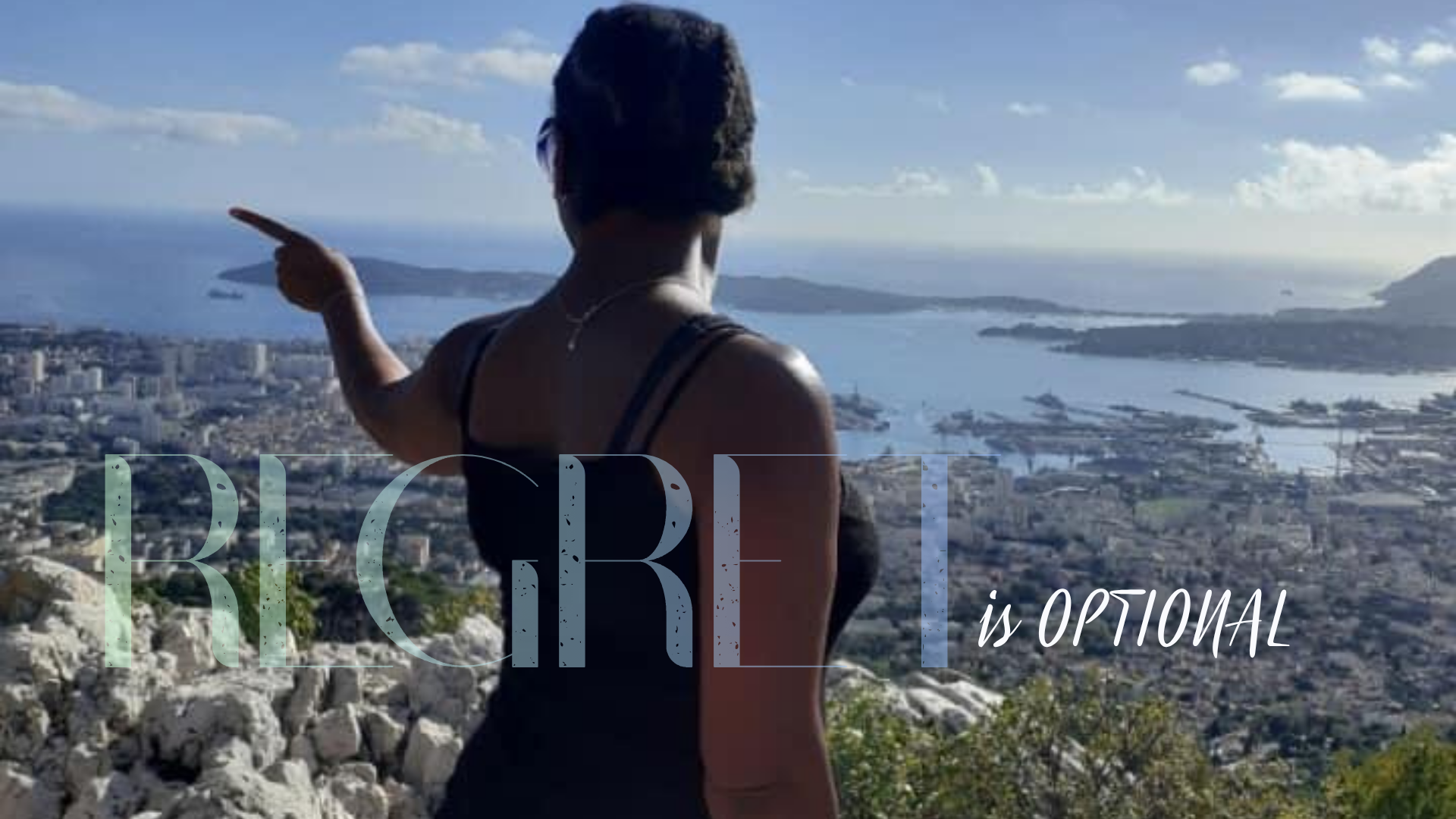
Fear is inevitable, REGRET IS OPTIONAL !
“I want to talk about a comment I received on a recent video. Now, this person clearly hadn’t watched it — they saw the thumbnail and reacted. And out of what I believe was genuine concern, they suggested I should have waited longer before sharing my engagement, so I wouldn’t look foolish. I’m not sharing this to call anyone out. I’m sharing it because this comment reflects something so many of us carry — this deep fear that if we move fast, if we choose boldly, if we change direction — people will laugh. And that fear can stop us cold.”
“Here’s what I’ve come to know after years of watching women over 50 completely reinvent their lives: you never look foolish. You never look foolish for choosing yourself. You never look foolish for saying ‘I want more.’ You never look foolish for taking a chance on love, or a new career, or a new city, or a new version of who you are. Never. The people who judge you harshly — who watch your life and see ‘foolishness’ — are almost always people who judge themselves harshly too. People who are afraid to take their own leaps. People who are not at peace with their own lives. Their judgment is not about you. It never was.”
“Think about the people in your corner. The ones who texted you when you made the announcement. The ones who showed up when you took the risk. Did any of them say ‘you look foolish’? No. Because the people who love you — who are rooting for you — they aren’t keeping score. They’re celebrating your courage. The audience that matters in your life is not the comment section. It is not the family member who side-eyes your choices. It is not the stranger who saw your thumbnail and had opinions. The audience that matters is you. And the people who’ve earned a seat at your table.”
“There’s something that happens to women after 50. We start to understand how much time we may have wasted worrying about other people’s opinions. And we start to ask a different question. Not ‘what will they think?’ but ‘what do I want my life to look like?’ That shift is everything. Reinvention after 50 isn’t reckless. It’s informed. You’ve lived enough life to know what you don’t want. You’ve survived enough hardship to know you can land on your feet. Starting over after 50 isn’t the act of someone foolish. It’s the act of someone who’s finally done waiting for permission.”
“If you’re watching this because you’re in the middle of a reset — a divorce, a new relationship, a career change, a move, a comeback of any kind — I want you to hear this: you are not foolish. You are not naive. You are not moving too fast. You are living. And the people who don’t understand that are simply not your people. You don’t owe your timeline to anyone. You don’t owe your choices to anyone. Take the chance. Make the announcement. Send the application. Book the flight. Buy the dress. Live your life out loud.”
“I’d love to know — have you ever held yourself back because you were afraid of looking foolish? Or have you taken the leap anyway? Tell me in the comments. And if this resonated with you, please share it with a woman in your life who needs to hear it today. I’ll see you in the next one.”